William Eggleston
Four Black Children off Highway
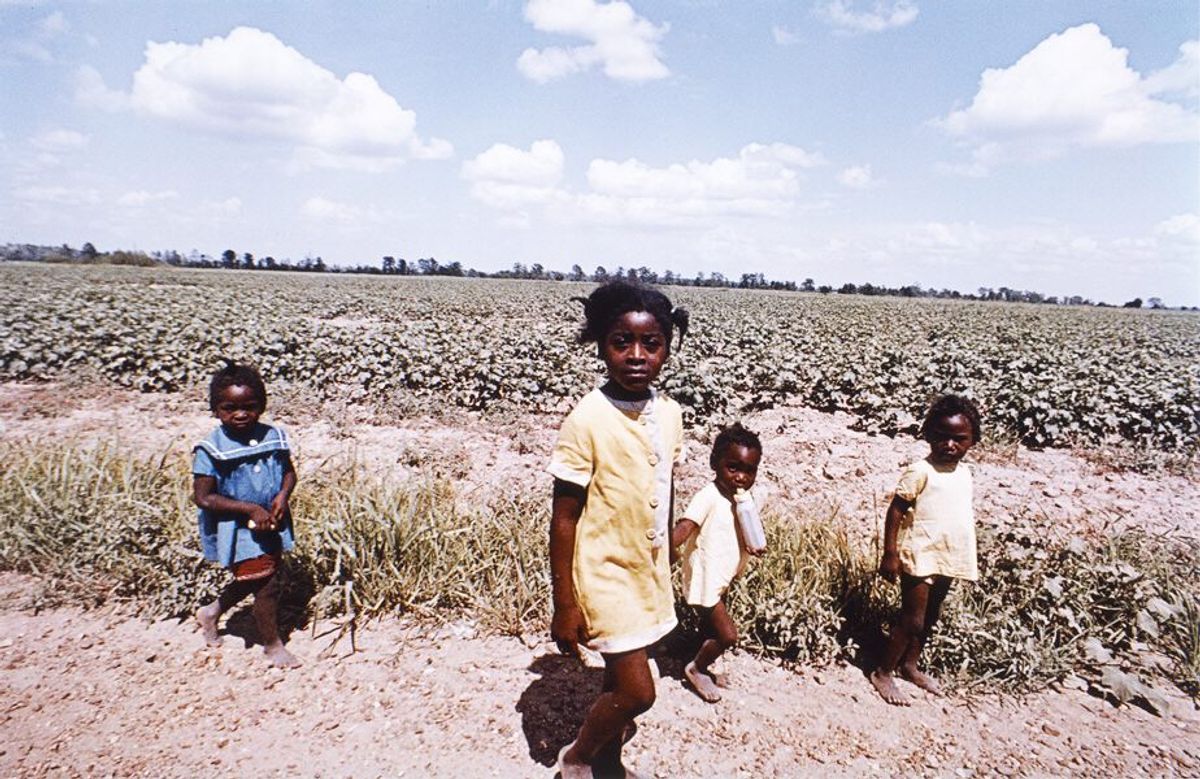
Four Black Children off Highway, 1980
From Troubled Waters Portfolio
Dye-transfer print, 29 x 44 cm
Collection Fotomuseum Winterthur
2001-012-002
© The Eggleston Artistic Trust, Memphis
b. 1939 (Memphis, US), lives and works in Memphis, US
William Eggleston is interested in apparently incidental subjects, which he makes the focus of his work, applying his ‘democratic gaze’ to them. His observations, which look casual but are consciously composed, provide insights into the everyday, consumer culture of the Southern United States in the 1960s and 1970s. He used vibrant colour to take pictures of sugar shakers on the table of a diner, the bonnets of parked cars or a row of milk cartons on the cooler shelf of a supermarket. Although Eggleston began his career with black-and-white images photographed in the style of Henri Cartier-Bresson, he switched to Kodachrome colour film in the 1960s. In making his prints, he often used the dye-transfer process, which, like colour photography itself, had hitherto been mainly used in advertising and afforded a wide tonal range. However, even though some practitioners started experimenting with colour at an early stage, black-and-white photography continued to predominate in art and photojournalism until the 1970s. Photographs by William Eggleston, his 1976 show at the Museum of Modern Art, and William Eggleston’s Guide, the catalogue accompanying the exhibition, had a major impact, and the photographer is thus regarded as one of the pioneers who paved the way for colour photography’s acceptance in art.